

One question that comes to the minds of many (new) Betta fish owners is whether it’s possible to get a few friends for their fish. After all, doesn’t one single betta with an entire aquarium to itself eventually become awfully lonely? Although there are a few options when it comes to Betta tankmates, your fish is actually just as well (or even better) off without them.
Keep reading for the do’s and don’ts of Betta tankmates!
Note: Contrary to popular belief, Bettas (Betta splendens) cannot be kept in bowls. They need an aquarium of at least 5 gallons (19L) to thrive. For more information about Betta care have a look at the Betta fish caresheet.
How to choose Betta tankmates
When choosing tankmates to keep your Betta company, keep in mind that these fish don’t actually need company. They don’t care if they’re alone; if you add other fish or inverts that’s solely for your own entertainment. In tanks under 15 gallons (57L), avoid adding other fish entirely. Many people will see a low-energy Betta and think that it’s that way because it’s lonely, which is a dangerous assumption to make. If a Betta is lethargic, you’re likely dealing with a health problem rather than loneliness!
Betta fish also often don’t want company. They are solitary, aggressive fish. We have spent centuries breeding them to be aggressive so that they will beautifully display to each other and other fish for our entertainment. Because of this, safely keeping Bettas in community tanks can be difficult, even deadly. Here are a few of the main reasons why Bettas are not the best choice for community tanks:
- Although aggression levels vary between fish, both males and females are generally quite territorial, not to mention carnivorous. They will attack anything that looks too much like another Betta and some will view anything small as a yummy snack. The article about why Betta sororities are bad goes deeper into the issue of the popularity of keeping female Bettas together.
- At the same time Bettas are also rather timid and vulnerable, which means they are easily stressed out by anything that moves too fast, is too colorful or wants to nip their fins. Although they often accused of being the bully in a fish tank, it’s important to remember that they can be bullied, too! Bettas that don’t have enough hiding places can become stressed out by constantly being exposed to other fish, especially energetic schooling fish.
- The large-finned varieties are especially prone to being harassed by tankmates since their heavy fins make it harder for them to swim away. This can lead to damaged fins due to nipping. Open sores can lead to a compromised immune system, which can spread illness quickly throughout the community. Unfortunately, large-finned Bettas can also be outcompeted for food since they’re just not fast enough to keep up!
- Lastly, Bettas require relatively warm temperatures that are just a little too toasty for many species and don’t do well in hard water with a high pH level.
All this means that there are a lot of bad Betta tankmates: any fish or invertebrates that are colorful, fast, aggressive or need different water values should be avoided, which is unfortunately the majority of species in the aquarium trade. Combining your Betta with these fish and inverts can lead to stress, aggression and even death in some cases.
Bad Betta tankmates
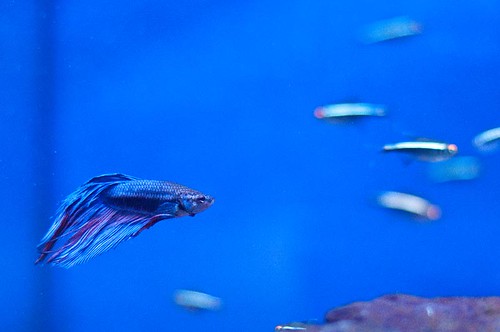
Many species that fall into one of the four categories listed above (colorful, fast, aggressive, need different water values) are marketed as good Betta tankmates even though they’re not. So which fish should you avoid?
- Other Bettas. This includes multiple females! Although increasingly popular, Betta “sororities” are actually a poor choice and at risk of fatalities.
- Schooling fish (most). Yes, that includes popular choices like white cloud mountain minnows. These in particular are actually bad Betta tankmates as they are too active and need much cooler temperatures. Also includes neon/cardinal tetras (too colorful) and livebearers like guppies and mollies (too colorful and active).
- African dwarf frogs. Another very popular choice, African dwarf frogs are easily outcompeted for food and might be nipped at. They’re better for a single species setup! Read more about African dwarf frogs here.
- Ghost shrimp . Although some shrimp work well with Bettas, ghost shrimp are known to be able to damage your fish.
- Goldfish. Goes without saying. These grow much too large and need cold water.
- Cichlids. Colorful, aggressive, active, large. Nope!
- Gourami. Although they are actually cousins of your Betta splendens, gourami fish are not a good choice. The two species will most definitely see each other as rivals.
Even if a species is not on this list, take a long hard look at it before you even consider adding it to your Betta tank. The best option is to just choose a species from the list below.
Good Betta tankmates
So, you’ve found a fish or invertebrate that is not colorful, very active, aggressive or in need of different water values? Great! As long as it’s suitable for your tank size it might be an option. But always keep in mind: when in doubt, just don’t.
The species with an asterisk (*) are fish I’d personally avoid just in case but have been reported to work in many cases.
- Snails. Probably the best option as long as your Betta doesn’t like to nip at their antennae. Nerites, Malaysian trumpet snails, assassin snails and mystery snails (the latter are only suitable for tanks of 15 gal/57L and up) should work.
- Shrimp (except ghost shrimp). This is a bit of a hit and miss because many Bettas love themselves a shrimp snack. If there are plenty of hiding places in the form of plants and shrimp flats, dwarf shrimp like red cherries or Amano shrimp might work.
- Kuhli loaches. If your aquarium is suitable for them these are an alright option. They spend a lot of their time hiding and shouldn’t interfere with your Betta. Provide hides like coconut halves to give them a chance to take cover from the Betta as needed.
- Otocinclus catfish. An alright option, but only for experienced aquarists. These are extremely fragile and sensitive to bad water values.
- Corydoras catfish. Also an alright option, although these are pretty active they stick to the bottom water layer. Pygmy Corydoras are especially appreciated for Betta tanks, but always be careful. Like Otocinclus catfish, pygmy Corydoras are especially sensitive to bad water values and are only recommended for established tanks that have been running for months or years.
- Hara jerdoni catfish. Like many of the other species on the list, these are bottom dwellers. They spend much of their day in hiding or sitting relatively still, meaning they neither make a target for your Betta nor will they target it themselves. As an added bonus they have a similar diet of insects and worms.
- Harlequin Rasbora, ember Tetra*. Calm, not too colorful schooling fish. This could work, but I personally wouldn’t take the risk.
Keep in mind that even if you choose a fish or invert from this list, it might not work with your Betta. Always have a plan B in case of aggression or stress (a back-up tank or a place to rehome fish to).

If you have any more questions about tankmates for Bettas or want to share your own experiences, don’t hesitate to leave a comment below!


