It doesn’t matter whether you’re a beginner aquarist without much experience or an expert who’s looking for green without having to worry about upgrading lighting and CO2 installations — everyone needs a hardy, easy-to-care-for aquarium sometimes.
Easy plants are decorative, remove nutrients from the water, and provide fish with a place to hide all while being low maintenance. That means no CO2, no extra lights, and no specific water values.
Keep reading for a list of plants that will be able to survive in the hands of even the worst plant-keepers and most low-tech setups, all while looking just as lush as more sensitive plants!
Why do you need aquarium plants?
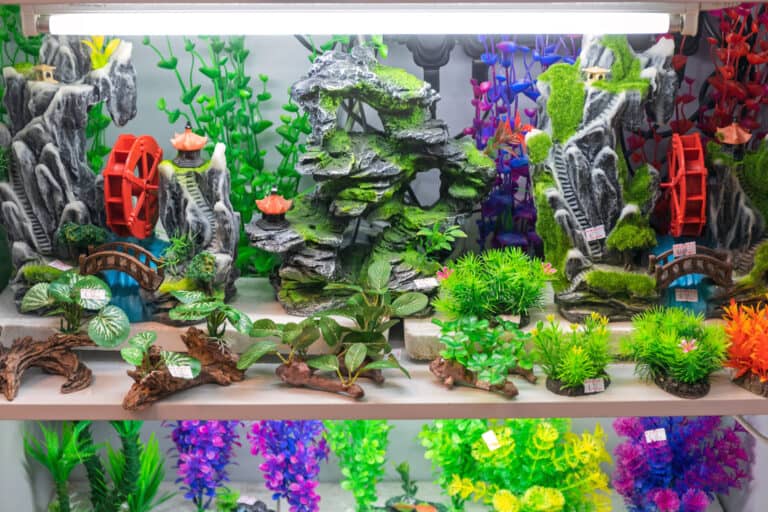
Why do aquarists keep plants in their systems? Won’t artificial plants work just as well?
Yes, artificial plants are an excellent choice if you’re only hoping to provide your fish with the sense of being in its natural environment, but you’re missing out on many other benefits when you choose not to add live plants to your aquarium.
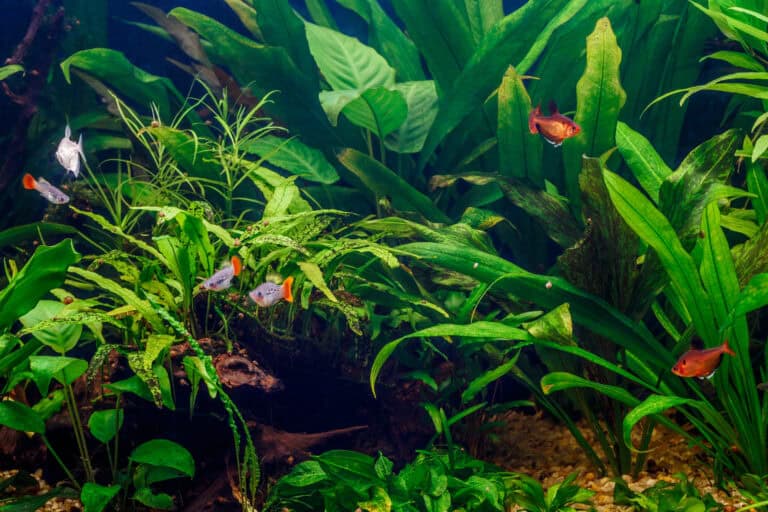
Keeping live plants doesn’t need to be hard if you choose the right species, but if you don’t add them at all, you’re missing out on nutrient uptake, oxygen supply, and of course, natural beauty.
Nutrient uptake
If you’ve ever kept a garden before, you know that plants require nutrients to give the best flowers and harvests possible. Aquatic plants are no different and require most of the same nutrients as terrestrial plants.
Live plants help with taking up nitrates and phosphates, which are often the culprits of unwanted algae growth, making them a natural remedy for frustrated hobbyists. Live plants also help take up ammonia and nitrite, which can be beneficial when starting a new tank.
However, some of the more colorful and advanced plants need a supply of trace elements, like iron and potassium, which sometimes need to be dosed through a dry or liquid fertilizer.
All the plants on our list will be just fine with regular fish food feedings and the other waste that floats through the aquarium water!
Oxygen supply
Live plants undergo photosynthesis in the aquarium. This is the process by which plants use carbon dioxide, light, and water to make food (sugar) and oxygen.
Fish, invertebrates, and other microbes do the exact opposite: introduce carbon dioxide into the water. This means with live plants, there is a constant exchange between used carbon and new oxygen always being circulated in the tank.
However, there is also a balance between nutrient uptake, light, and oxygen, which gets more complex with harder plants; if you have really high lighting and a good amount of plants in your aquarium, you will most likely need a carbon dioxide system and fertilizers.
Luckily, the plants we recommend in this article won’t require high lighting or a carbon dioxide system!
Natural beauty
We admit some artificial plants can look better than live plants. However, artificial plants never change, and you don’t get to see your aquarium come to life with growth.
It should also be said that some artificial plants can actually be harmful to your fish as they can have sharp edges and be made of harmful materials.
How do you choose aquarium plants for your fish tank setup?
For plants, it’s best to do some research ahead of time and go to a reputable fish store that has each species labeled.
You’ll often see plants floating in tanks without any indication of their names, which will make giving proper care difficult.
One of the best things you can do is look at videos and visit forums of hobbyists who have fish tank setups similar to yours and see which plants they’ve had success with; it doesn’t hurt to do some additional research on your own as well.
When you decide on the plants you want, look for lively and vivid plants, but be prepared for them to melt slightly when you add them into your tank.
Do aquatic plants need specific water parameters?
Most aquatic plants are very forgiving of water parameters, though they might not do well with sudden changes.
As mentioned before, new plants tend to melt once you add them to your aquarium. This is due to shifts in water parameters, water flow, lighting, and general changes in environmental conditions.
While some plants can withstand less-than-perfect conditions, a good rule of thumb to note is if fish can live in your tank, then most plants can, too.
Do you need CO2 for a planted aquarium?
Carbon dioxide, or CO2, is not required for most casually planted tanks.
If you’re keeping more advanced plants or a lot of plants, then you will probably want to look into a carbon dioxide system; red and carpeting plants, for example, are especially known for needing lots of CO2.
Our Favorite Easy Aquarium Plants
Here is a list of what we’ve deemed the most undemanding aquarium plants.
Most of these species require low to moderate lighting, no fertilizers, and a very low level of care, making them good options for both beginner and advanced hobbyists alike.
Java moss (Taxiphyllum barbieri)

Used in aquariums throughout the world, this undemanding, hardy species is the most popular of all mosses available in the aquarium trade.
Java moss can provide hiding places for tiny fry and shrimp, but it’s also often used for decoration. You can tie it to rocks and driftwood with a fishing line or leave it free-floating in your tank.
If you’d like to get creative, floating Java moss balls or Java moss-covered coconut hides are also a great choice. You can even create a lush Java moss wall by attaching the plant to a mesh plate. Once given some time to grow, this can look pretty amazing!
When it comes to proper lighting conditions, this moss is very undemanding. It can survive in a wide range of water conditions and temperatures that are just as diverse. In fact, it’s one of the few freshwater aquarium plant species that can grow in low-end brackish water as well.
For bushy growth, trim Java moss when it gets too thick to keep the lower parts healthy and green.
If you’re interested in a more advanced type of moss, then check out our guide on Christmas moss here!
Amazon sword (Echinodorus amazonicus, Echinodorus bleheri, etc.)
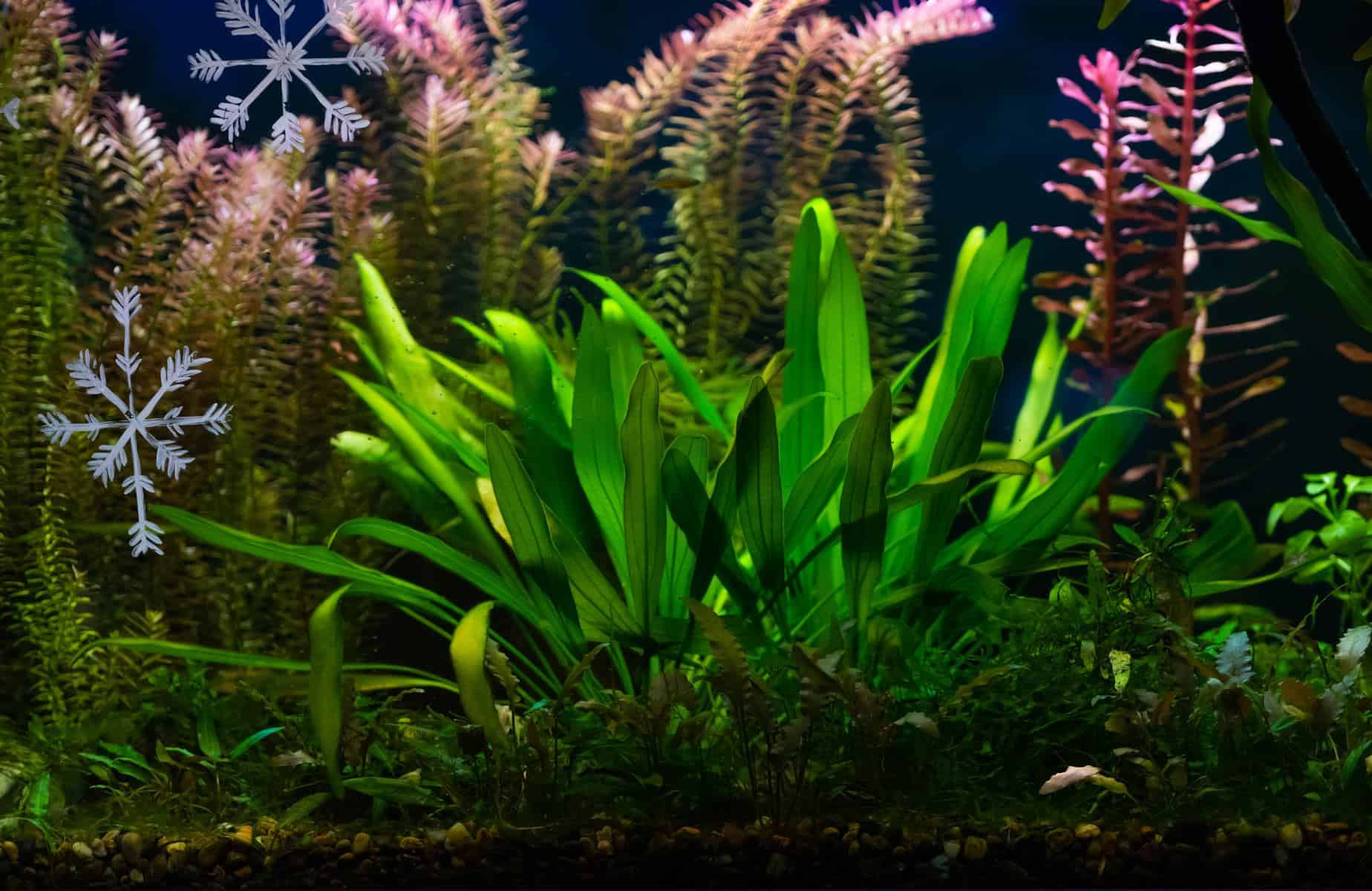
Famous for the enormous size it can reach even with low light conditions, the Amazon sword is most suitable for bigger tanks as a background aquarium plant.
Amazon sword is a root feeder, so it might require some additional root fertilizers for healthy growth; however, simple root tabs every few months are usually enough.
When provided with everything it needs, the Amazon sword can turn into a “monster plant” and reach an impressive size of almost 2 feet (60 centimeters).
Fish will appreciate the long, sword-shaped green leaf coverage, while shrimp see them as a perfect foraging spot. The fast-growing plant is ideal for excess nutrients if you’re struggling with an unbalanced tank.
Consider allowing your Amazon sword to grow above the water surface, too. If you do this, you might just be rewarded by the occasional flower.
You can find more information about Amazon sword care, planting, and propagation here.
Java fern (Microsorum pteropus)
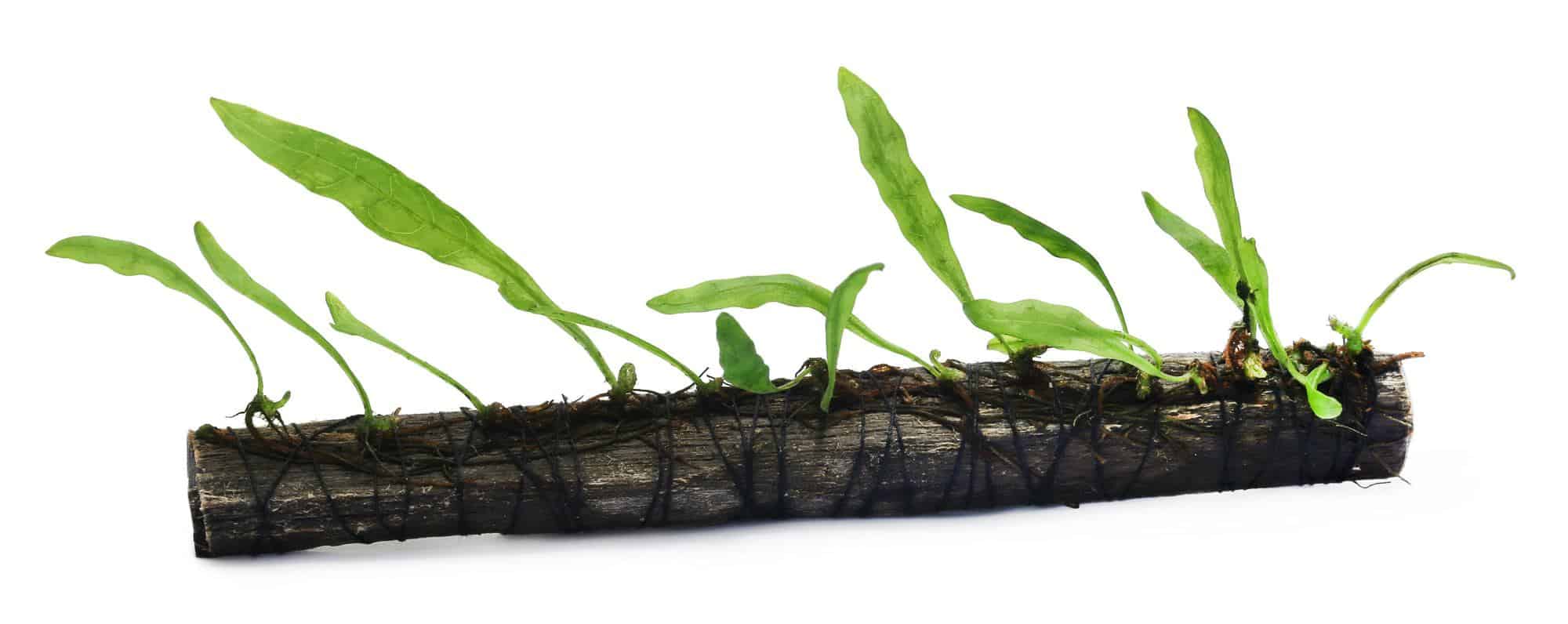
Although Java fern can be a slow-growing plant at first, this popular species is unstoppable once it becomes established!
Java fern can survive in almost any aquarium and comes with the advantage of having hard, leathery leaves that are almost indestructible. Even notorious plant-eaters like goldfish will usually leave this species alone.
This plant doesn’t require strong lighting or specific water values, making it a great plant for beginner hobbyists and low-tech aquariums. Java fern does need to be tied down to a rock or driftwood to grow properly, as it hasn’t evolved to grow in the substrate.
Java fern is also available in many varieties, so if you don’t like the typical assortment, go for Windeløv-, narrow leaf-, trident- or Philippine Java fern. Each has a different growth pattern and leaf shape, meaning there’s an ideal choice for every aquarium.
A full Java fern care sheet can be found here.
Vallisneria (Vallisneria spiralis, gigantea, etc.)
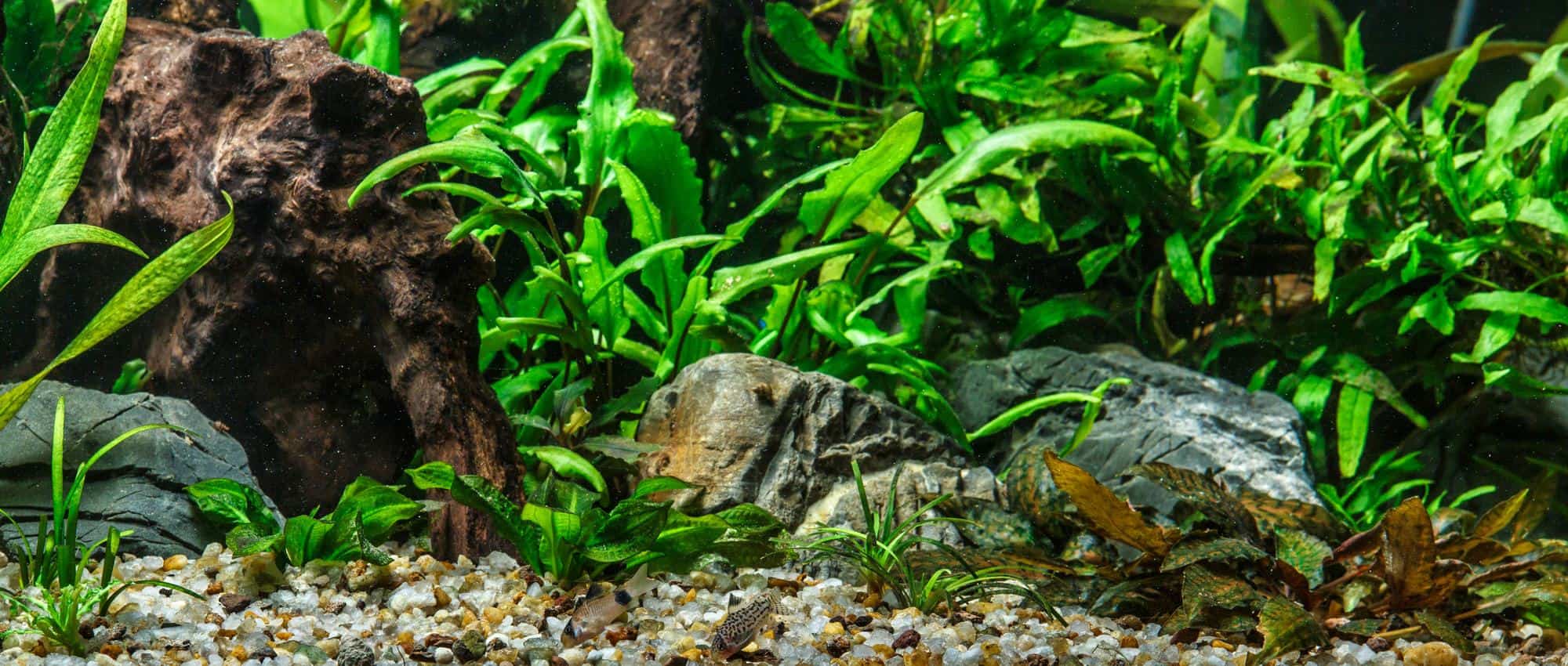
Vallisneria is another tall plant with subspecies suitable for almost every aquarium.
This species can easily adapt to a wide range of water and light conditions. Although it doesn’t have the fastest growth rate, you will quickly see runners with small new leaves appear around the mother plant.
If the runners are not removed, Vallisneria will form a dense field in a relatively short amount of time. This is a great background plant option if you keep fish that appreciate being provided with plenty of covers.
Do keep in mind that the soft leaves of Vallisneria may be seen as a snack by some fish species — it’s even edible for us humans! This can sometimes make keeping it with herbivorous fish tricky.
I like to grow Vallisneria in tanks that have shy fish like bettas and dwarf puffers. I’ve found that there’s no need to worry about never seeing your fish again.
As paradoxical as it might sound, having the option to retreat to a safe place actually gives species like these the courage to come into the open more often.
A full care sheet on this green-leaf giant can be found here.
Amazon frogbit (Limnobium laevigatum)
If you’re looking for a hardy, fast-growing floating plant to provide your fish with some shade, look no further!
Amazon frogbit is one of the most popular floating plants out there, and its easy care makes it an ideal plant for beginners.
Frogbit grows very quickly, even in less than ideal water conditions. It helps keep your water parameters stable between maintenance rounds by absorbing extra nutrients, like nitrates and phosphates, which can lead to algae growth over time.
Its long roots make a great place for skittish fish to hide in and help prevent stress while the shade provided by the leaves can help break up the lighting throughout the tank.
Remember, frogbit doesn’t handle harsh lighting or being underwater for extended periods very well. A low-light environment is better for this species than a high-tech setup with a very strong lamp.
If left to multiply, it can also suck up a majority of the nutrients in your tank. But with the right care, it has many benefits!
Anubias (Anubias barteri, Anubias nana, etc.)
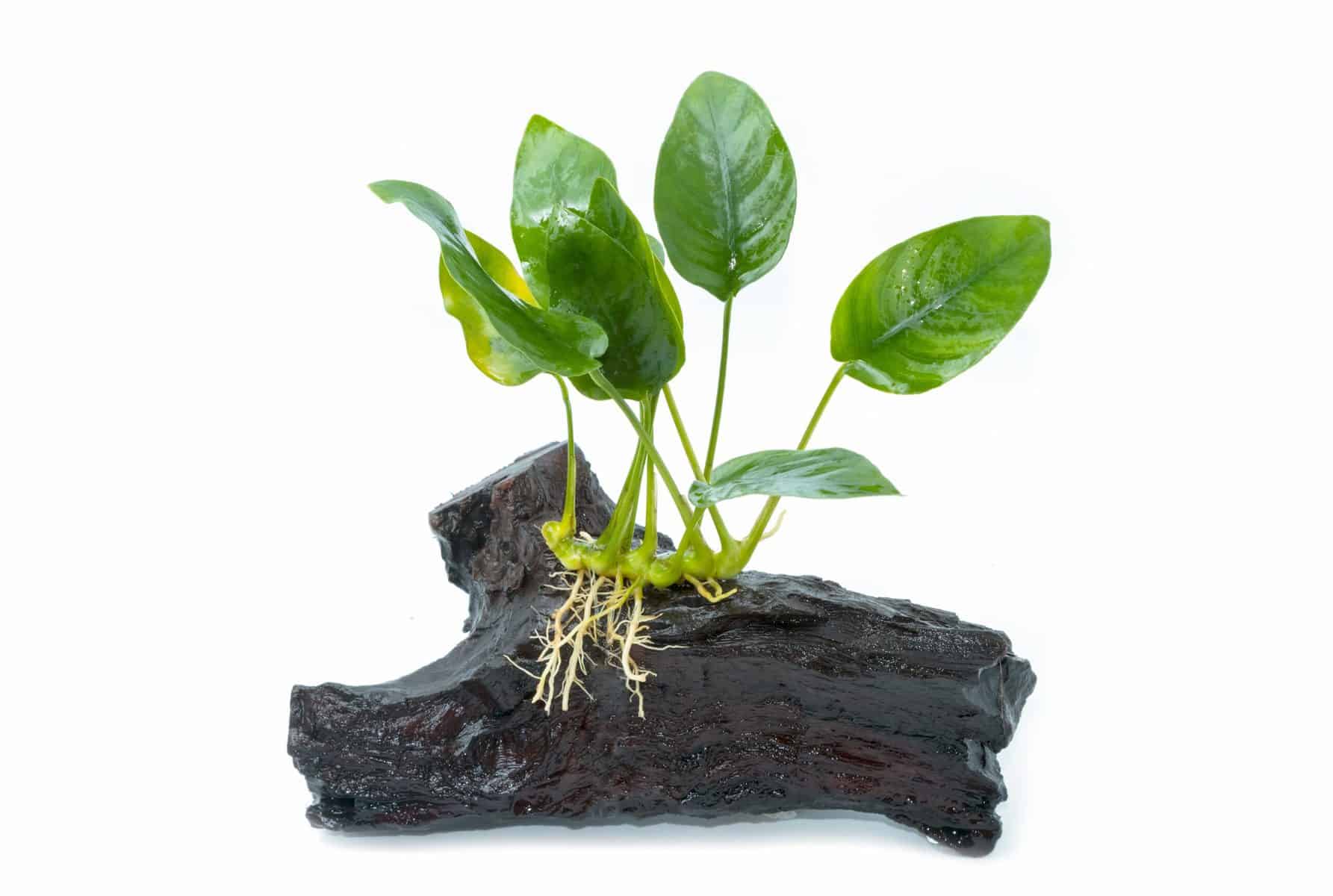
Anubias is one of the few plants that actually prefer low-light conditions. This, along with the fact that even plant-eating fish seem to leave it alone, makes it a great addition to many types of aquariums.
Anubias won’t appreciate being planted in the aquarium substrate; it does best when tied to or glued down to rocks or driftwood. It looks especially good in small groups of multiple plants and the broad leaves make a great sitting or sleeping place for fish.
Anubias is primarily a foreground plant, but hobbyists get creative and can find a spot for them at all levels of the tank.
Trim your Anubias regularly by removing leaves now and then with a pair of scissors to keep it looking good. If you allow it to grow above the water, it may even reward you with a lovely white flower!
Crypts (C. wendtii, C. spiralis, and C. crispatula, etc.)
If you’ve just bought a crypt, you may be disappointed to see it dying within a few weeks. However, there is no reason to be discouraged!
Cryptocoryne species are well known for their tendency to shed old leaves (this is called melting) after being moved from one aquarium to the next; most times, they quickly grow back into a larger plant.
Crypts do well in low-light settings, and although their slow growth rate can be discouraging, they can quickly start to have bushy growth after they’ve acclimated!
Cryptocoryne is available in many different varieties, including an attractive red form and a dwarf form that has compact growth for carpeting purposes.
Anacharis (Egeria spp.)
Anacharis is a very popular type of plant for beginners, though more advanced hobbyists will consider it a terrible weed!
Anacharis has an optimal growth rate for hungry herbivorous fish and invertebrates, and species that need some green in their diets, like goldfish, will appreciate freshly-grown plants.
This species of plants’ fast growth rate is also helpful if you need to combat an algae problem as it can quickly take up nutrients. However, this balance will need to be watched closely so there are still some nutrients left for other plants.
Anacharis can be left floating but grows fine when planted as well. Note that this popular plant might melt in your tank but should be replaced by fresh, lively leaves very quickly.
Bucephalandra spp.
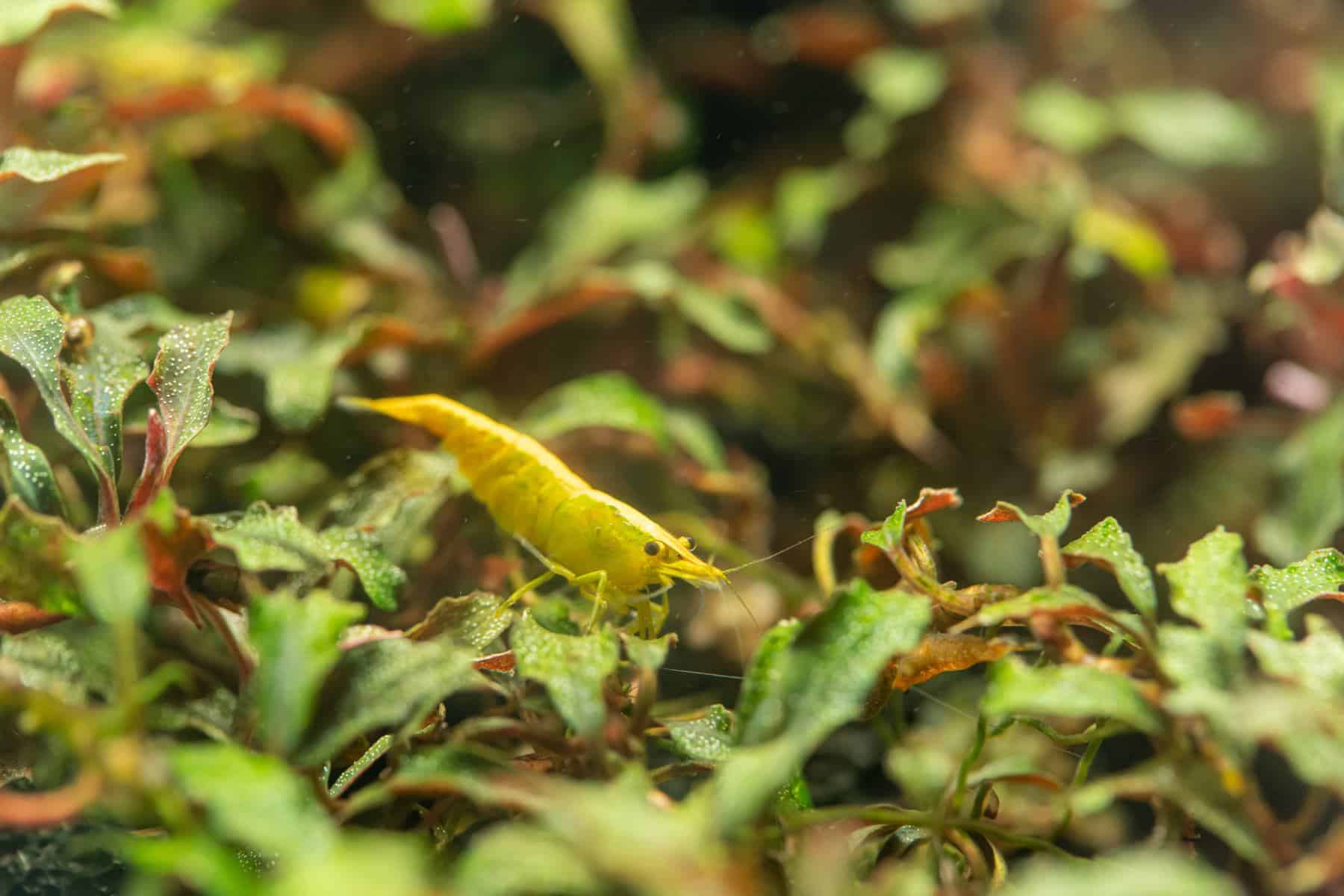
Plants from the genus Bucephalandra seem endlessly captivating to aquarists; their beautiful colors and different sizes make it tempting to want to collect every species out there.
Bucephalandra care is pretty similar to that of Anubias and Java fern. This plant is also a rheophyte that grows on rocks and driftwood in its natural habitat in Borneo. It doesn’t need a high light level and has adapted to grow both submersed and emersed.
There is an endless variety of Bucephalandra species out there. Many haven’t even been scientifically named yet, and new varieties are regularly being discovered.
The most popular variety in aquarium stores today seems to be ‘Wavy Green‘, which is named after the characteristic bends in its leaves.
Conclusion
As you can see, there is a whole assortment of easy freshwater plants that don’t require the fanciest lighting or tank setup; and luckily, most of them are very cheap as well!
Remember, aquarium plants should never be released into local lakes or rivers. Doing this can cause damage to natural habitats and native species might be outcompeted for nutrients, light, and space.
If you have to get rid of unwanted plants, you can sell them, destroy them, give them away or dispose of them properly. Composting is also a great option.
If you have any more questions about the plants on this list or want to share your own experiences, don’t hesitate to comment below!