

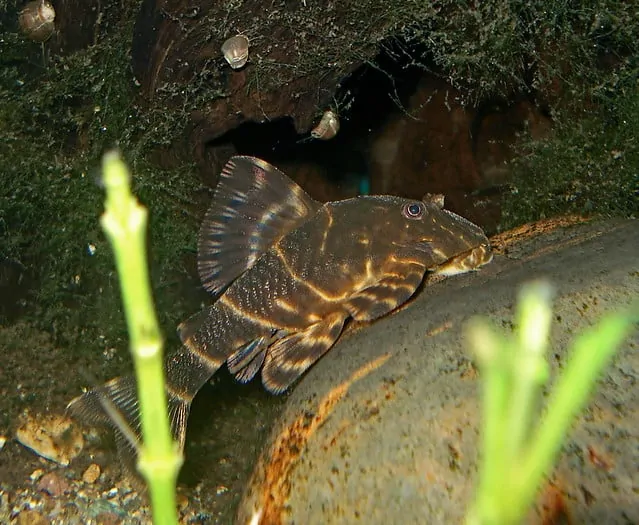
Quick Answer
Clown plecos (Panaqolus maccus) are wood-eating dwarf catfish that max out around 3.5-4 inches. They need driftwood as a primary food source—not just decoration—and produce heavy waste despite their small size. Minimum 20 gallons, sand substrate, and multiple caves.
Here’s what most clown pleco guides get wrong: they list this fish as an “algae eater.” It’s not. The clown pleco is a wood-rasper. Its entire digestive system is built to process the biofilm and decaying outer layers of submerged driftwood. If you buy one expecting it to clean your glass, you’ll be disappointed and your fish will be malnourished.
That said, if you want a small, beautifully patterned Loricariid that won’t outgrow a standard aquarium, the clown pleco is one of the best options available. It stays under 4 inches, breeds readily in captivity, and has genuine personality once it settles in.
Quick Care Overview
Identification and Appearance
The clown pleco’s coloration varies more than most guides acknowledge. The base pattern is dark brown to black with lighter bands ranging from cream to bright orange. But here’s the part that trips people up: those bands can be straight, wavy, or broken depending on the collection locality. L104, L162, and LDA022 are all considered regional variants of the same species, though some hobbyists still debate this.
Color intensity changes with mood, age, and diet. A stressed clown pleco washes out to dull brown. A well-fed, settled specimen in dim lighting shows the most contrast. If your fish’s colors are perpetually faded, that’s diagnostic—something in the environment isn’t right.
Tank Setup
The 20-gallon minimum gets repeated everywhere, and it’s accurate—but not for the reason most guides give. It’s not really about swimming space. These fish are sedentary. The issue is waste production.
Wood cannot be efficiently digested. A clown pleco eating driftwood produces significantly more solid waste than a similarly-sized fish on a conventional diet. In a 10-gallon, ammonia can spike between water changes even with light stocking. A 20-gallon gives you enough buffer to maintain stable parameters with weekly maintenance.
[WARNING] Waste Production
Don’t let the small adult size fool you. Clown plecos produce disproportionate waste due to their wood-based diet. Strong filtration and regular substrate vacuuming are non-negotiable, not optional.
Substrate
Sand is the clear choice. Clown plecos spend most of their time on or near the bottom, and their undersides are vulnerable to abrasion. Sharp gravel can cause sores that lead to secondary infections. Fine sand also makes it easier to spot and remove waste during maintenance.
Hardscape and Hides
Driftwood isn’t optional decoration—it’s the primary food source. Malaysian driftwood, mopani, and spider wood all work. The fish rasp the softened outer layer, so wood that’s been submerged and developed biofilm is more valuable than fresh pieces.
You’ll also need dedicated hiding spots beyond just driftwood tangles. Ceramic pleco caves with narrow openings work well and double as breeding sites. The counterintuitive truth about shy fish: more hides means you see them more often. A clown pleco with only one retreat becomes a recluse. Give it four options and it gains the confidence to explore.
Lighting and Plants
These fish come from shaded riverbanks where dense vegetation and overhanging trees block direct light. Floating plants like Amazon frogbit or water lettuce help replicate this and reduce stress.
A note on planted tanks: clown plecos rasp. They’re adapted to scraping wood, and they’ll sometimes scrape plant leaves the same way. Thin-leaved plants like cabomba or fine-leaved stems get shredded. Stick to robust species—Amazon swords, anubias, and java fern handle the occasional attention without damage.
Diet: The Part Most Guides Get Wrong
The “just do a water change and drop in an algae wafer” advice you’ll see everywhere misses the point with this species. Clown plecos are specialized wood-eaters. Driftwood needs to be present and accessible at all times—not as an occasional supplement, but as the foundation of their diet.
In addition to the wood constantly available in the tank, supplement with:
- Cholla wood — Soft enough for easy rasping, can be replaced as it breaks down
- Blanched vegetables — Zucchini, cucumber, whole peas, sweet potato (they’re reportedly obsessed with yams)
- Sinking wafers — Spirulina-based or algae wafers, but these are supplements, not staples
- Protein occasionally — Frozen bloodworms, brine shrimp, or daphnia once or twice weekly
[TIP] Pro Tip
If you have a carefully aquascaped driftwood centerpiece you don’t want damaged, the clown pleco is not your fish. They will eat it. That’s not a defect—it’s the entire point of keeping them.
Tankmates
Clown plecos occupy the bottom stratum and generally ignore midwater fish entirely. They work well in peaceful community setups with tetras, rasboras, and other non-aggressive species.
For a biotope-accurate South American setup, consider:
- Corydoras habrosus or other dwarf corys (different feeding niche, minimal competition)
- Cardinal tetras (Paracheirodon axelri)
- German blue rams (similar water parameters)
The territorial issue that matters: clown plecos defend caves against their own species and other small Loricariids. One clown pleco per 20 gallons is the safe rule. If you want multiples, add 10+ gallons per additional fish and provide more caves than fish. Two plecos with two caves will fight over the “better” one. Two plecos with four caves usually sort themselves out.
Behavior
Expect a shy, nocturnal fish that spends daylight hours wedged under driftwood. This isn’t a centerpiece species. You’ll see it most at dawn, dusk, and when food hits the tank. Some individuals become bolder over time, especially in dimly-lit setups with plenty of cover, but “bold” for a clown pleco still means brief forays across open substrate before retreating again.
If you want an active pleco you’ll actually see, this isn’t it. If you’re fine with occasional glimpses of a beautifully patterned fish doing its own thing in the background, the clown pleco delivers.
Breeding
Clown plecos breed more readily than most dwarf Loricariids—one reason they’re relatively available in the hobby despite many specimens still being wild-caught. Success requires triggering their natural seasonal cycle.
Breeding Process
[FACT] Clown plecos can live 10+ years with proper care. If you’re not ready to maintain an aquarium for a decade, consider whether any Loricariid is right for you.
Common Mistakes
The failure mode I see most often: someone buys a clown pleco expecting an algae crew, puts it in a tank without driftwood, drops in algae wafers twice a week, and wonders why the fish fades, hides constantly, and eventually dies. The fish wasn’t sick—it was starving on an inappropriate diet.
Second most common: underestimating territory needs when keeping multiples. Two clown plecos in a 20-gallon with limited caves results in one dominant fish and one perpetually stressed, hidden fish that never thrives.
Frequently Asked Questions
Do clown plecos eat algae?
Not significantly. Clown plecos are wood-eaters, not algae-eaters. They’ll occasionally rasp biofilm that includes some algae, but they won’t clean your glass or control an algae problem. If you need algae control, look at otocinclus, nerite snails, or Amano shrimp instead.
How big do clown plecos get?
Adult clown plecos typically reach 3.5-4 inches (9-10 cm). Occasional specimens grow slightly larger, but they remain true dwarf Loricariids—nothing like the common pleco that can exceed 18 inches.
Why is my clown pleco always hiding?
That’s normal behavior. Clown plecos are nocturnal and naturally reclusive. You’ll see them most at feeding time and in low light. Paradoxically, adding more hiding spots often increases visibility—the fish feels secure enough to venture out more frequently.
Can I keep multiple clown plecos together?
Yes, but you need space. Add at least 10 gallons per additional fish and provide more caves than plecos. They’re territorial toward their own species, and cramped conditions lead to one fish dominating while others decline from stress.
How long do clown plecos live?
With proper care, clown plecos commonly live 10-12 years. This is a long-term commitment. Poor diet (especially lack of wood) and unstable water quality are the main factors that shorten lifespan.
[INTERNAL LINK: “dwarf pleco species” -> bristlenose pleco care guide]
[INTERNAL LINK: “nitrogen cycle” -> cycling a new aquarium]