

Quick Answer
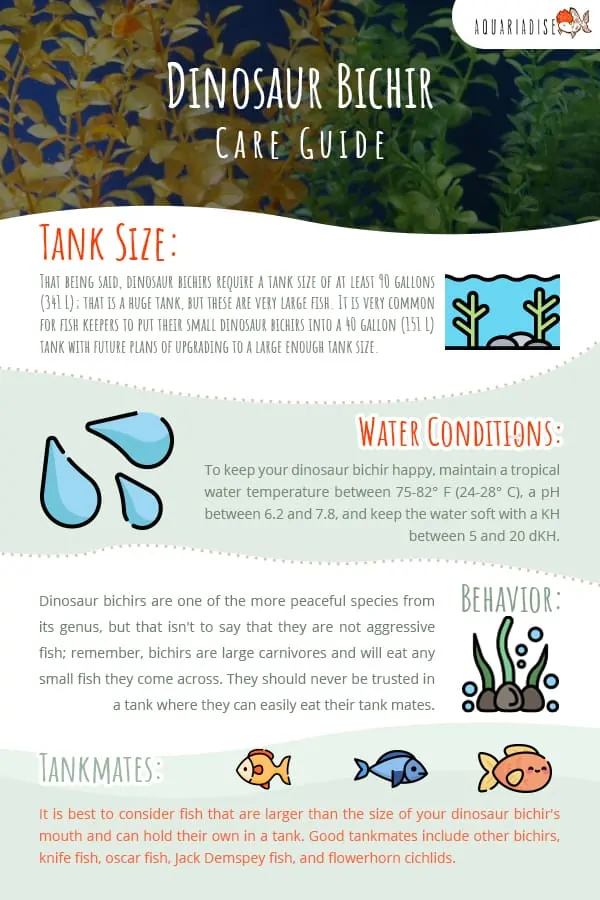
Dinosaur bichirs (Polypterus senegalus) need a minimum 90-gallon tank, a tight-fitting lid with air gap, sand substrate, and a carnivorous diet of live or frozen foods. They’re hardy once established but require a 30-year commitment and careful planning for their 20-inch adult size.
That baby bichir at the pet store looks manageable at four inches. The problem is what happens six months later when it’s tripled in size and you still haven’t upgraded from the “temporary” 40-gallon. I’ve watched this exact scenario play out dozens of times in the hobby, and it almost never ends well for the fish.
Dinosaur bichirs are genuinely rewarding to keep. They’re ancient, armored, and have more personality than most bottom-dwellers. But the gap between “looks cool” and “actually prepared to keep one” is wider than most care guides acknowledge. Here’s what you actually need to know.
Quick Care Overview
Why They’re Called “Dinosaur” Bichirs
Polypterus senegalus goes by several names: dinosaur bichir, Senegal bichir, Cuvier’s bichir, grey bichir, and dragonfish. You’ll also see “dinosaur eel” — which is wrong, since they’re definitively fish, just elongated ones.
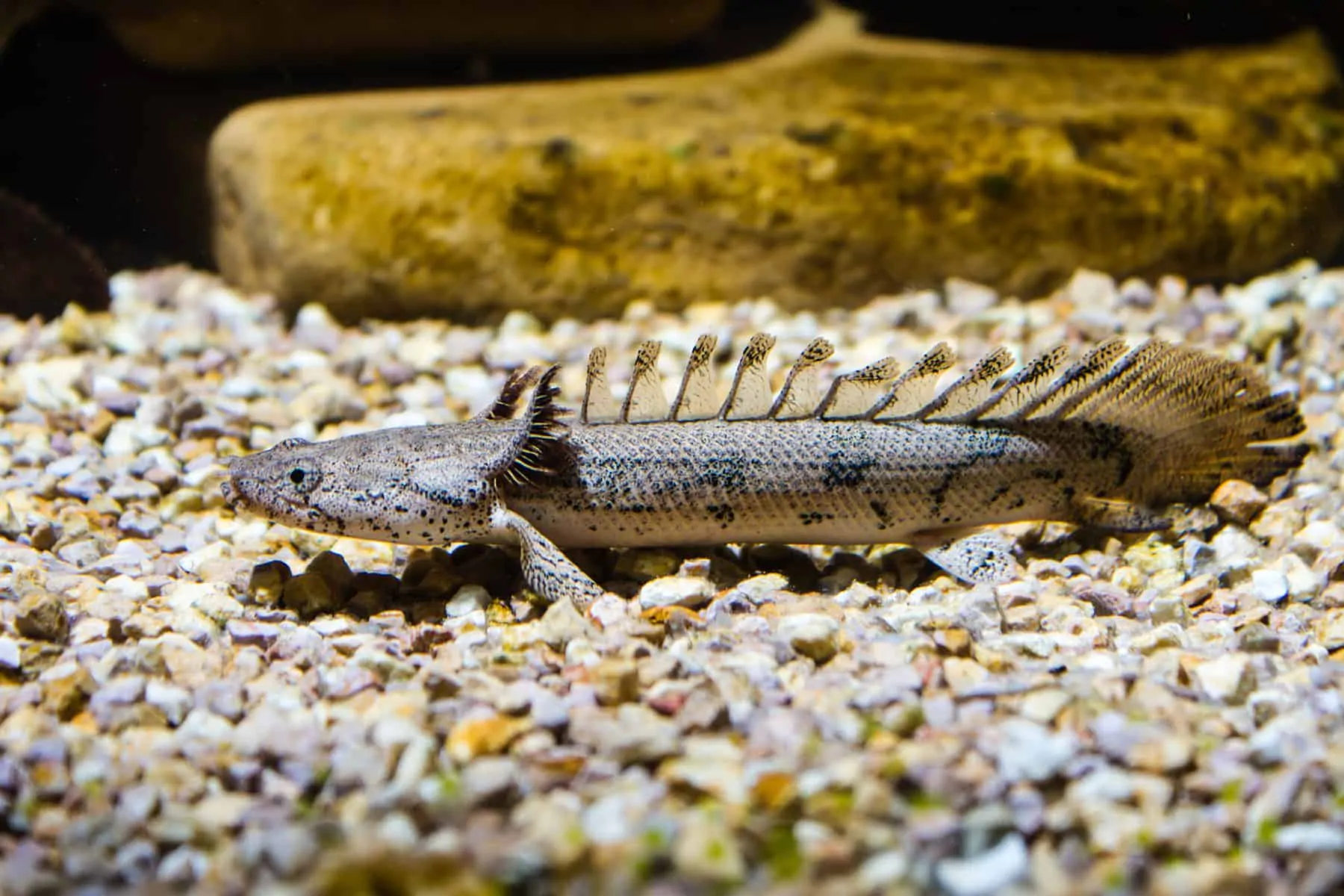
The “dinosaur” part isn’t marketing hype. Fossils from ancestral Polypterus species date back 200 million years. These fish genuinely look like something that should be extinct, with their armored ganoid scales, serrated dorsal fin, and primitive lobed pectoral fins they use to “walk” across the substrate.
Did You Know?
Dinosaur bichir skin has been studied by materials scientists for developing better flexible body armor. The interlocking ganoid scales provide both protection and mobility — a combination engineers struggle to replicate.
Natural Habitat
Dinosaur bichirs are widespread across Africa, occurring in over 26 countries including Egypt, Kenya, Nigeria, and Senegal. They inhabit slow-moving freshwater — shallow lakes, floodplains, swamps, and the margins of the Nile River system.
The water in these habitats is typically murky with poor visibility. Bichirs have adapted by developing a strong sense of smell and the ability to detect weak electrical currents — they’re hunting by sensing their prey, not seeing it. Their eyes are almost vestigial at this point.
This murky-water adaptation has another consequence: bichirs have evolved primitive lungs alongside their gills. They regularly surface to gulp air, which allows them to survive in low-oxygen conditions. It also means they can survive brief periods out of water — and that they can technically drown if prevented from reaching the surface.
Tank Requirements: The 90-Gallon Minimum Is Real
Here’s where most guides fail you. They’ll mention the 90-gallon minimum, then immediately suggest you can start with a 40-gallon “grow-out tank.” Don’t do this.
The upgrade almost never happens. You get busy, the larger tank costs more than expected, or you convince yourself the fish seems fine. Meanwhile, your bichir is stunted, stressed, and living in inadequate conditions. If you can’t commit to 90 gallons from day one, wait until you can.
[WARNING] Escape Artists
Bichirs are notorious for finding gaps in aquarium lids. They will climb filter intakes, squeeze through tiny openings, and end up on your floor. Use a tight-fitting lid with no gaps larger than a pencil — but leave space between the water surface and lid so they can breathe air.
Substrate and Decor
Sand is the clear choice. Bichirs spend most of their time on the bottom, pushing themselves along with their pectoral fins. Gravel can scratch their underside and trap uneaten food. Fine sand lets them move naturally and makes cleanup easier.
Driftwood provides hiding spots, though bichirs are surprisingly indifferent to decor. They’ll use cover if it’s available but won’t stress without it. What matters more is floor space — prioritize horizontal swimming room over elaborate aquascaping.
Water Parameters
Dinosaur bichirs are genuinely hardy once established. Aim for:
- Temperature: 75-82°F (24-28°C)
- pH: 6.2-7.8
- Hardness: 5-20 dKH (they prefer softer water)
Stability matters more than hitting exact numbers. Weekly partial water changes keep parameters consistent and prevent nitrate buildup. These aren’t delicate fish, but they’re also not invincible — don’t let “hardy” become an excuse for neglect.
Behavior and Activity
Despite their size, dinosaur bichirs are one of the more peaceful Polypterus species. “Peaceful” still means predatory — anything that fits in their mouth will be eaten — but they’re not aggressive toward similarly-sized tankmates.
They’re nocturnal by nature, becoming most active after lights out when they hunt for food. That said, many keepers successfully shift their bichir’s feeding schedule earlier by gradually moving feeding time back. It takes patience, but you can have a bichir that’s active during viewing hours.
One of their more entertaining behaviors is surfacing to breathe. You’ll see your bichir swim up, gulp air, then return to the bottom. This isn’t a sign of poor water quality — it’s completely normal and part of what makes them fascinating to watch.
Diet: Why Pellets Alone Won’t Work
This is the part that separates committed bichir keepers from those who give up. Dinosaur bichirs are obligate carnivores. Standard tropical flakes and pellets won’t cut it — they need actual meaty foods.
[TIP] Pro Tip
Bichirs hunt by smell, not sight. Drop food in the middle of the tank and let them find it. Waving food in front of their face usually doesn’t work — they need time to sense the food in the water column.
A proper bichir diet includes:
- Live foods: Earthworms, feeder fish (quarantined), ghost shrimp
- Frozen foods: Bloodworms, silversides, prawns, tilapia chunks
- Freeze-dried: Shrimp, krill (rehydrate first)
Some keepers supplement with high-quality carnivore pellets like Hikari Massivore or cichlid pellets. This can work as part of a varied diet, but shouldn’t be the primary food source. If your bichir won’t take pellets, don’t force it — plenty of healthy bichirs eat exclusively live and frozen foods.
Tankmates
The rule is simple: if it fits in the bichir’s mouth, it will eventually end up there. This eliminates most common community fish.
Successful tankmates are fish that are too large to eat and can tolerate the same conditions:
- Other bichirs (same size or larger)
- Oscar fish
- Jack Dempsey cichlids
- Flowerhorn cichlids
- Knife fish
- Large catfish (Synodontis, larger Plecos)
Many keepers run species-only tanks, and honestly, a single dinosaur bichir in a well-designed 90-gallon is plenty engaging on its own.
Plants are fine — bichirs ignore them completely since they’re hunting for meat, not grazing. Use whatever plants you want; the bichir won’t care.
Other Bichir Species
If you’re drawn to bichirs, you might consider these relatives:
| Species | Adult Size | Notes |
|---|---|---|
| Dinosaur Bichir (P. senegalus) | 20″ (50 cm) | Most common, smallest of the popular species |
| Delhezi Bichir (P. delhezi) | 12-15″ (30-38 cm) | More patterned, stays smaller |
| Ornate Bichir (P. ornatipinnis) | 24″ (60 cm) | Striking black/yellow pattern, needs larger tank |
| Saddled Bichir (P. endlicheri) | 30″ (76 cm) | Largest common species, extended lower jaw |
“Albino bichir” isn’t a separate species — it’s typically an albino morph of P. senegalus with pink/red eyes and a white body.
Breeding: Don’t Plan On It
Breeding dinosaur bichirs in home aquariums is essentially impossible. It’s been achieved at professional facilities, but specifics are scarce and the conditions required aren’t replicable in typical setups.
In the wild, breeding occurs during rainy season. Temperature drops, pH shifts, and flooding trigger spawning behavior. The male chases and nudges the female; if successful, she scatters eggs across the substrate. Parents would eat the eggs immediately if not removed.
If you’re buying bichirs, assume they’re wild-caught. This means quarantine is essential — wild-caught fish commonly carry parasites that can devastate an established tank.
Sexing
Telling males from females is difficult and mostly pointless given the breeding challenges. Males have slightly thicker anal fins; females may be marginally larger overall. Unless you’re attempting a professional breeding program, don’t worry about it.
Buying Tips
Before purchasing, ask yourself honestly: do you have a 90-gallon tank ready right now, and are you prepared to maintain it for potentially 30 years? If the answer to either is no, wait.
When selecting a bichir:
- Ask to see it eat — a healthy bichir has a strong feeding response
- Look for clear eyes and intact fins
- Check for any white spots, fuzzy patches, or rapid gill movement
- Quarantine for 4-6 weeks minimum since most are wild-caught
[FACT] Most dinosaur bichirs in the trade are wild-caught from African river systems. Captive breeding is rare enough that tank-bred specimens command significant premiums when available.
The Bottom Line
Dinosaur bichirs are genuinely fascinating fish — ancient predators with primitive lungs, armored scales, and behaviors you won’t see in typical aquarium species. They’re also a serious commitment that most casual fishkeepers aren’t prepared for.
If you have the space, the budget for live foods, and a 30-year timeline in mind, a dinosaur bichir can be one of the most rewarding fish you’ll ever keep. If any of those factors feel uncertain, there’s no shame in admiring them at the fish store and choosing something else for now.
Frequently Asked Questions
How big do dinosaur bichirs get?
Dinosaur bichirs typically reach 14-18 inches in captivity, with some specimens growing to their full 20-inch potential in larger tanks with optimal conditions. Growth rate depends heavily on diet quality and tank size.
Can dinosaur bichirs live with other fish?
Yes, but only with fish too large to eat. Good tankmates include oscars, Jack Dempseys, flowerhorns, knife fish, and other bichirs of similar size. Any fish small enough to fit in their mouth will eventually become food.
Why does my bichir come to the surface to breathe?
This is completely normal. Bichirs have primitive lungs in addition to gills and regularly gulp air at the surface. It’s not a sign of poor water quality — it’s an ancient adaptation that allows them to survive in low-oxygen waters.
What do dinosaur bichirs eat?
Dinosaur bichirs are carnivores that need live or frozen meaty foods: earthworms, bloodworms, shrimp, silversides, and feeder fish. Some accept carnivore pellets as a supplement, but they shouldn’t be the primary diet.
How long do dinosaur bichirs live?
With proper care, dinosaur bichirs can live 20-30 years in captivity. This is a significant commitment — consider whether you’re prepared to maintain a 90+ gallon tank for decades before purchasing.
[INTERNAL LINK: “carnivore pellets” -> best food for predatory fish]
[INTERNAL LINK: “bloodworms” -> bloodworms feeding guide]
[INTERNAL LINK: “oscar fish” -> oscar care guide]

I have a dinosaur bichir in a 75 gal tank of assorted African Cichlids. Do you forsee any potential issues or concerns?
Not many hobbyists like to keep bichirs with cichlids in small aquariums. There’s the possibility of the bichir eating smaller cichlids as well as the cichlids picking on the bichir. Your tank is also way too small to allow for the potential size of the bichir as well as the possibility of aggression.
Hey William! I know you said it is difficult to tell the sex of a bichir, but I just wanted to know if you could give me some tips so I can tell if my dinosaur bichir is a male or female?
Hi Kim!
William can answer, but I have some insight too. Mainly, males have thick fins while females have more delicate, pointed fins.
This can be seen while they’re still juveniles but might become more apparent over time. Females are also generally larger.
Can Bichirs get along with arowana’s, rainbow sharks, pink tail chalceus, botias?
Hi William!
Bichirs will get along with arowanas, rainbow sharks, and pink tail chalceus, but possibly not with Botia as they both like to stay near the bottom of the tank. It should also be noted that any combination of these fish requires a HUGE setup and many can live over 10 years.